Agentic LLM social robot platform
The LLM brain of the humanoid robot Nadine: a ten-agent LangGraph system and a ReAct agent, with long-term and visual memory.
- result
- 4 first-author papers, 1.5B models beating a 22B teacher
- role
- PhD researcher, University of Geneva
- stack
- LangGraph, Ollama, QLoRA, ChromaDB, CLIP
- 10agents in the LangGraph dialogue graph
- 98.7%accuracy of my fine-tuned 1.5B models, beating their 22B teacher
- -53.5%latency after moving to the small fine-tuned models
- 0.87saverage response time with multimodal memory
Problem
A social robot has to talk with strangers, in public, in real time: recognize them, remember them, react to emotion, and answer before the conversation stalls. One prompt to one large model does not cover that, so I treated it as a systems problem.
System

Three platforms, three constraints
Same robot, three versions of the interaction layer. Each exists because of one hard constraint.
| Built for | Design | Models | Trade-off | |
|---|---|---|---|---|
| Multi-agent, local | Privacy and zero API cost: nothing leaves the machine | LangGraph graph of ten agents, each step separately testable | One LoRA-tuned Qwen2.5-1.5B per agent, served on-device by Ollama | Small tuned models stick to their training: new behavior needs new data, not a new prompt |
| Multi-agent, hybrid cloud | A user study on memory: stable understanding, predictable latency | Same graph; intent, affect and planning merged into one call bounded at 2.5 s | Hosted model for language, vision kept local to protect participants | Depends on the network and on a hosted model version |
| ReAct, cloud | Public demos: must not fail in front of an audience | Contextualizer, retrieval, then one ReAct loop with a fixed tool set | Hosted models | No persistent affect, no visual memory |
Memory
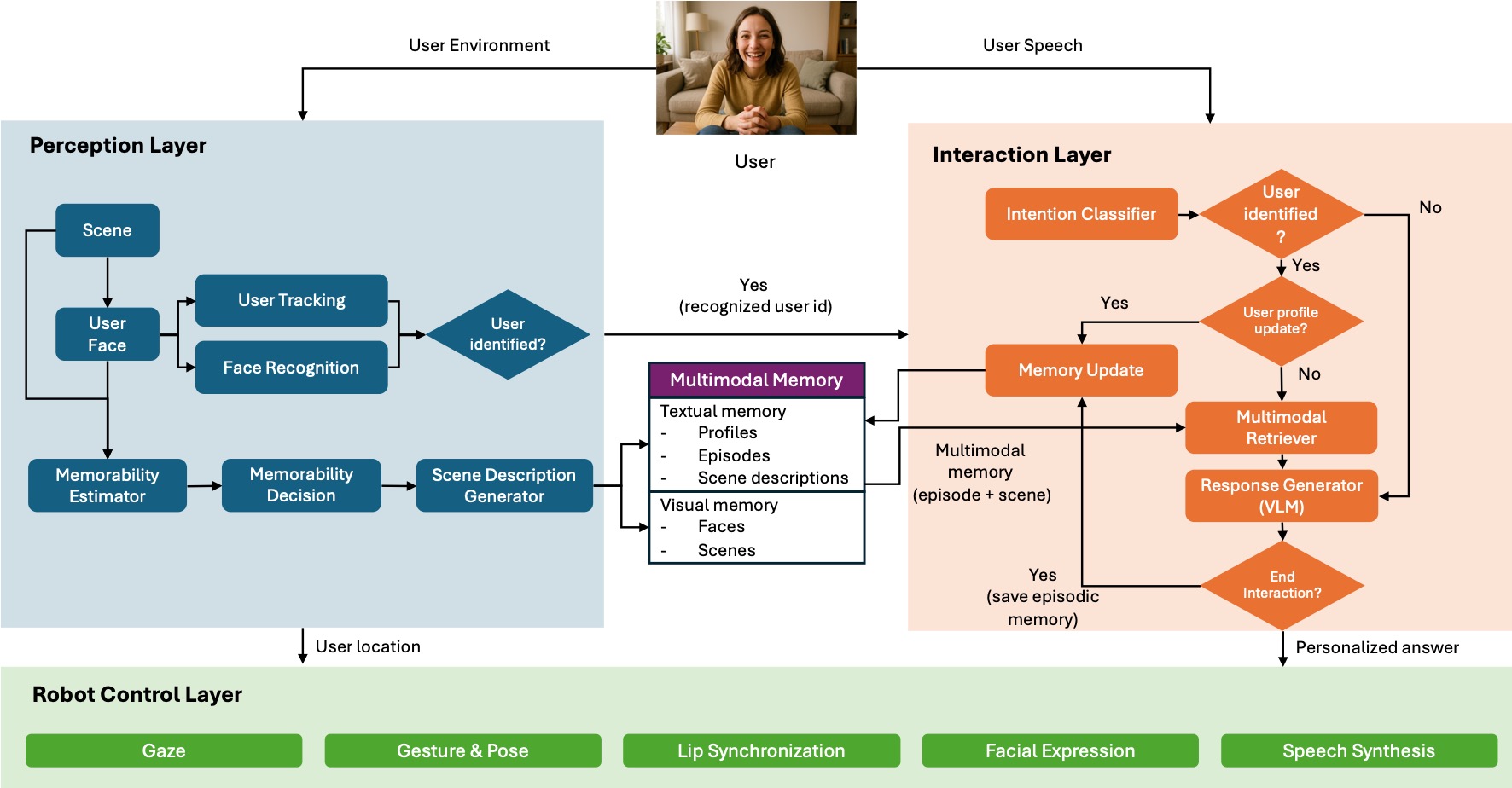
| What was measured | SUMMER | Reference |
|---|---|---|
| Agreement with human ratings of what is memorable (Spearman) | 0.506 | 0.415 between human raters; about 0 for standard image-memorability models |
| Retrieval over text and image together (Recall@1) | up to +13% | against text-only or image-only retrieval |
| Response time with memory | 0.87 s | 2 s limit for natural conversation |
Evaluation
- Ablations and benchmarks for tool-use recall and long-horizon memory, validated on LongMemEval.
- A user study on multimodal memory, run on the hybrid-cloud platform with its A/B mode.
- Two user studies with 123 participants and three years of public demos: see Nadine in the field.
Publications
- Human-Inspired Context-Selective Multimodal Memory for Social Robots. AAMAS 2026.
- Nadine: A large language model-driven intelligent social robot with affective capabilities and human-like memory. Computer Animation and Virtual Worlds, 2024. Wiley Top Viewed Article.
- Affective and Conversational Predictors of Re-Engagement in Human-Robot Interactions. International Journal of Social Robotics, 2026.
- From Sci-Fi to reality: exploring teenagers’ perceptions and ideas of AI robots. The Visual Computer, 2025.
PhD at MIRALab, University of Geneva (advisors: Prof. N. Magnenat Thalmann, Prof. S. Voloshynovskiy). Full technical documentation: Nadine Social Robot documentation.
